From Providence, we drove south to Newport, I’ve never been to its Welsh counterpart and can only say if it is only half as attractive as its Rhode Island namesake it must be pretty spectacular as Newport Rhode Island has very beautiful scenery, great architecture and interesting history. The island was developed for wealthy tourists in the late 19th and early 20th and when they say wealthy they mean Vanderbilt wealthy. The ‘Commodore’ left $100 million dollars to his children on his death in 1877, by some calculations it was the equivalent of $185 billion in today’s money. Two grandsons both built ‘cottages’ in Newport, we visited The Marble House built by William Vanderbilt for $11 million for his wife, Alva in 1892. Amazing house with only six bedrooms for the family (they don’t count the rooms for the 23 servants), built in Italian marble and furnished with European art bought by Alva on a shopping trip to Europe that was quite something else. This for a house they only spent around six weeks a year living in.

Alex gets ideas for our next home
We cycled along Bellevue Road where this mansion and dozens of others are located, many still privately owned but several now open to the public. Really amazing display of wealth and power. William Vanderbilt’s son, David, won the America’s cup three times while William’s daughter, Consuelo, married the 9th Duke of Marlborough which her mother bullied her into.
The rest of Newport has several historic places and very pretty houses alongside the mansions on Bellevue and with a history of sailing which continues with some enormous racing yachts in the harbour.
On Tuesday we got up early and cycled all of the way around Bellevue and then Ocean Drive, a very scenic route thankfully not too hilly as it took us an hour and an half to complete. We drove on to Cape Cod to spend the next three days in another location of rich Americans and history.
Many of the towns on Cape Cod are named after where the early Pilgrims originated and we went to Sandwich (strangely twinned with Sandwich in Kent) for lunch. Unfortunately, while a pretty little town it wasn’t a great lunch and not that interesting a town.
Our night was disturbed by rain and the next day we spent much of it cooped up inside Reg and only set off to visit Provincetown around 4pm. The journey took longer than expected and we rushed to get to the Pilgrim Monument before our guidebook said it closed at 5pm, hmmm … seems the guidebook was wrong and it was open until 6pm. We climbed up the tower built to commemorate the first landing of the Mayflower’s pilgrims on American soil, finding no easily available fresh water they pushed off again to what would become Plymouth and the founding of modern America. One minor point is they discovered a cache of corn seeds, most likely buried by native Americans for future planting, which they promptly stole. Bit concerned about the moral foundations of the country already!


After the monument, we walked down into Provincetown itself where we encountered bears of a completely different nature to those in Yellowstone and Yosemite! Seems Provincetown is the favoured holiday destination for the New England gay community and it was teeming (if that is a good collective term for them) with gay men. There were elegant drag queens, a jeep load of younger men promoting their review show (one of whom said to Alex they’d show her husband a good time!) and a lot of older men too. We went to dinner but declined the later enticements of Provincetown and returned tired after a long drive to our campsite.
Thursday, we went to Martha’s Vineyard on our bikes. We caught the ferry across from Woods Hole to Oak Bluffs. They operate two large vehicle ferries and the Thompsons were crammed next to a number of posher (for a pair of Walmart bikes) bicycles and four by four vehicles for the 45 minute journey. Being the US, there was a restaurant serving burgers and refreshments for the journey.
We cycled from Oak Bluffs to Edgartown along the seashore, a pretty cycle in lovely sunshine and flat. Edgartown’s large houses were built for the captains of the large whaling fleet that used to operate out of the town, on one of which Herman Melville worked. We went to the Sea Shanty restaurant for lunch where Alex had the New England speciality Lobster Roll, basically lobster mayonnaise in a white hot dog bun, and we both had a few beers while watching the pleasure craft in the harbour and the small car ferry shuttling backwards and forwards.
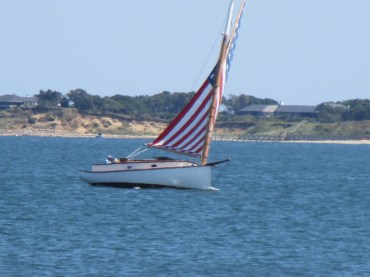
After lunch, we walked around the town where we saw the fashion sight of the holiday and one that will give me nightmares for years to come. There was an older lady walking down the street with a Zimmer frame who was wearing white cut-off jeans over her veined legs, I shudder at the thought even now.
Oak Bluffs was interesting for its estate of small wooden holiday cottages that were built for religious revival meeting visitors surrounding a large ‘temple’ with religious message exhorting the faithful.


Provincetown and Martha’s Vineyard were both great places to visit and rescued the area for us after some disappointment with the busy narrow roads that weren’t suited to Reg’s serene progression.
Friday, we drove to the Boston Minuteman Campground, while not being particularly near Boston, it was convenient for a train to Boston. We would be leaving Reg parked up here while we went downtown. Firstly, though we went to investigate the Minuteman part of the campgrounds name.
On Saturday, we went to the Minuteman National Historic Park in nearby Lexington. It’s situated along what is k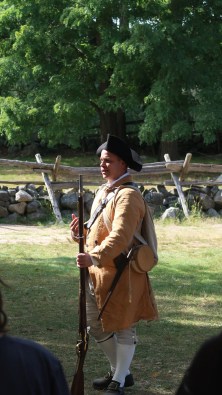 nown as Battle Road, this was the stretch of road between Boston and Concord Massachusetts where the first engagement occurred between what would become the United States forces and the British colonial forces. It was in Concord the Minute Men, so called because they could be ready at a minute’s notice to resist British attempts to suppress the rebellion, fired upon the Welch Dragoons, this engagement led to a retreat to Boston and over 200 casualties for the British forces. We learnt about Paul Revere’s ride from Boston to warn the local militia men of the British departure from their barracks and of the consequent skirmishing between the two sides. At the end of the day the US would have 4,000 men against 1,700 British troops and would start the siege of Boston. Washington would arrive to take command shortly after and the rest is history.
It was a really interesting introduction to the war and we walked along the route the soldiers took and met two park rangers dressed as early US patriot militiamen who gave us more insight into the day and its consequences.
More history to follow in the next instalment of Alex and Matts’ adventures in the United States
M
 Travelling Bradburys